Your best customers take a Las Vegas trip once or twice a year. Whether or not anyone at your property intended it, that trip becomes the benchmark they measure you against — not on gaming, where you are competitive, but on how a night feels.
This article is about what a regional property can borrow from that benchmark without a Strip budget, and about the two objections that usually stop the conversation before it starts: cost and logistics. It is written for anyone weighing Las Vegas entertainment for casinos outside the Las Vegas market.
One thing worth saying up front, because it is often implied and is not true: this is not an argument that local performers are inferior. Many are excellent, and a property that drops them is making a mistake. The problem regional properties have is not quality. It is arithmetic.
The freshness problem, stated honestly
A regional market has a finite talent pool. Not a bad one — a finite one.
A property programming entertainment weekly works through that pool within a year or two. After that, the same acts start reappearing on a cycle. And the guests who notice first are the ones you can least afford to bore: the regulars who are on your floor most weeks and represent a disproportionate share of your revenue.
The mechanic is simple and it is worth being precise about it. Entertainment that feels fresh to a first-time visitor is wallpaper to someone who has seen it eleven times. Any property optimising for visit frequency is, by definition, programming for an audience with maximum exposure to repetition.
So the property has three options. Program less often, which forfeits the reason to visit. Accept the repetition, which quietly stops working. Or widen the pool.
What “Vegas-caliber” actually means
The phrase is used loosely enough to be meaningless, so it is worth deflating and then defining.
It does not mean famous. Name talent is a separate market with a separate budget, and it is not what most regional properties need or are asking about.
What it does mean, in practical terms:
Performers who do this full-time. In a market with year-round demand across a large number of rooms, specialty performance is a career rather than a weekend supplement. That shows up in consistency more than in peak ability — the difference between an act that is excellent when everything goes right and one that is reliable when it does not.
Acts built for rooms with high production standards. Costume construction, prop finish and technical integration hold up under bright light and close inspection because they have to. Guests who have been on the Strip notice the difference in materials even when they cannot name what they are noticing.
Reliability standards set by properties that cannot absorb a failure. A no-show at a Las Vegas property has consequences that make no-shows rare. That discipline travels.
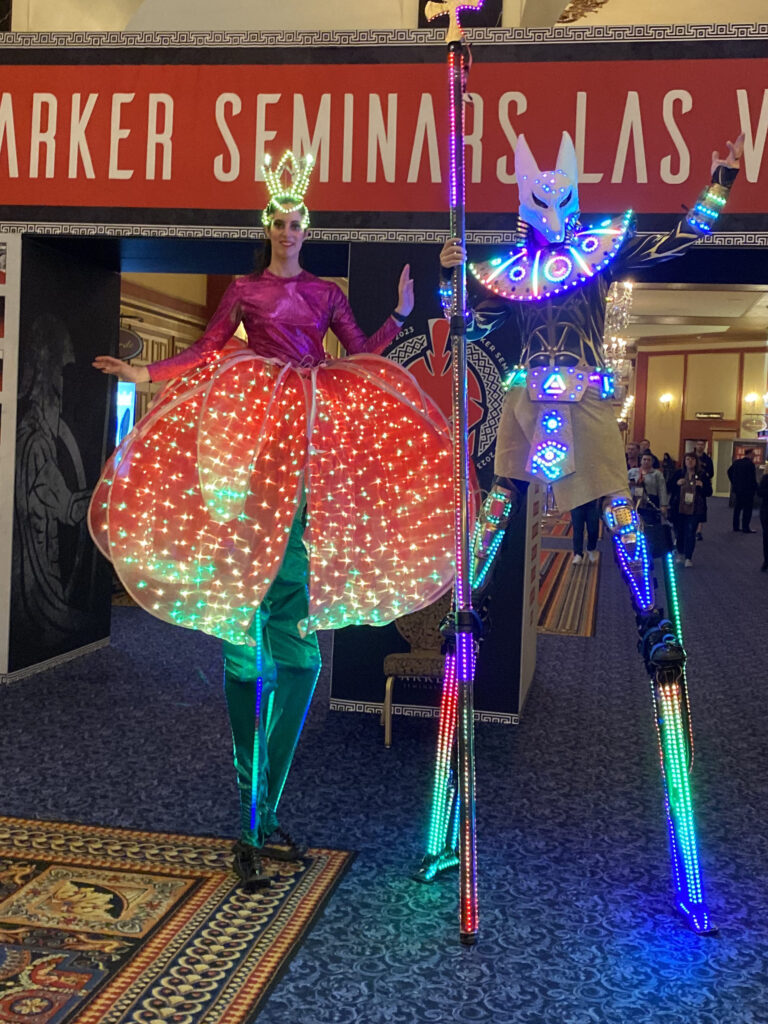
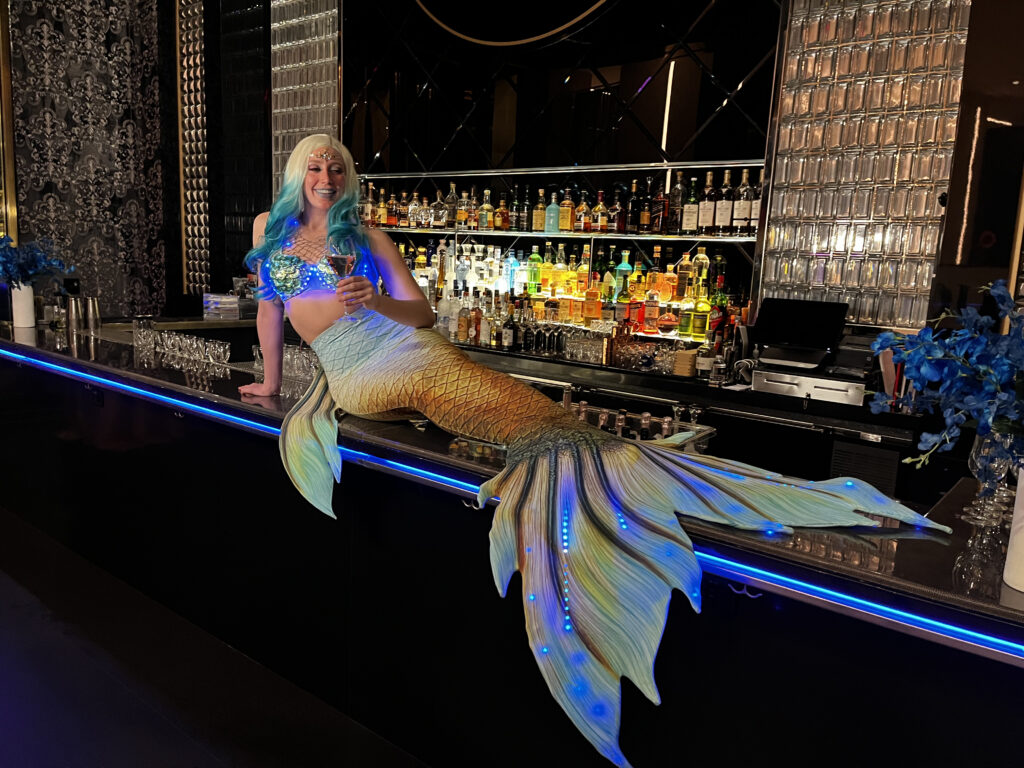
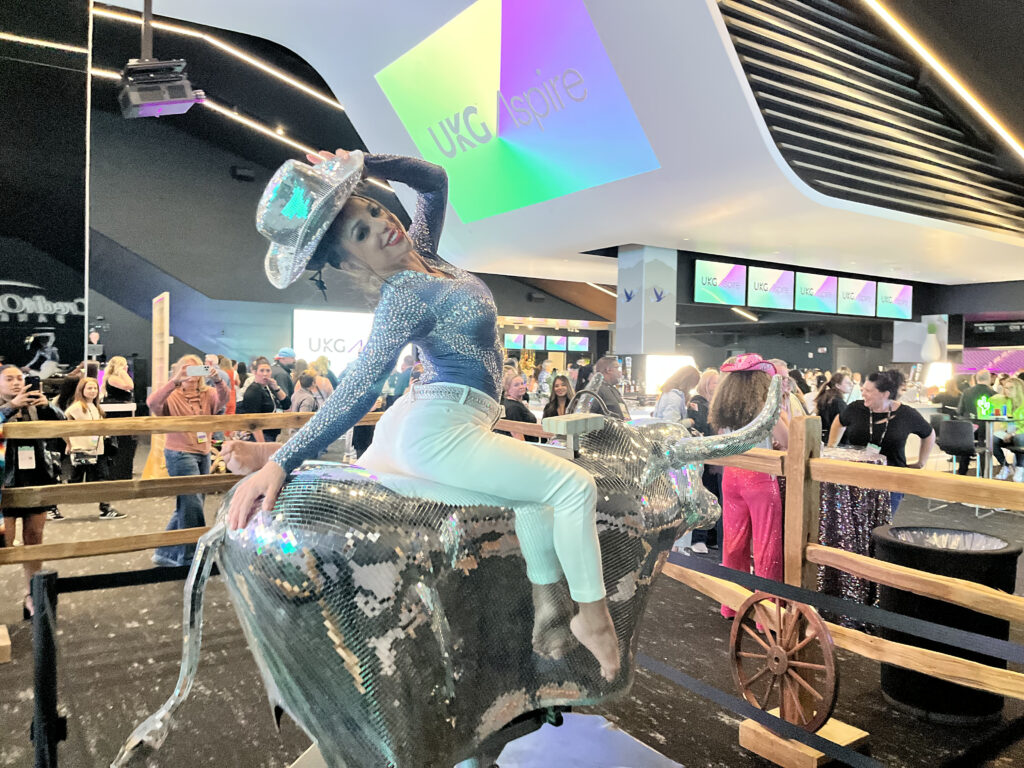
Depth of roster. The genuinely useful part. Not one better act — access to many different ones. Our own roster is in the gallery and the acts catalog.
This is not hypothetical. LightRay has brought LED performers and roaming entertainment into a full-scale resort casino environment at Yaamava’ Resort & Casino in Highland, California — a regional property, well outside the Las Vegas market.
The logistics are easier than most properties assume
This is where the conversation usually stalls, and it stalls on an assumption that has not been checked.
Las Vegas sits within driving distance of a large share of the Southwest’s casino properties — the Phoenix metro, the Southern California tribal corridor, southern Utah’s feeder markets, Laughlin and the Arizona river properties, and Nevada’s own regional markets. For most of these, out-of-market talent is a drive, not a flight.
Two of those are documented by the state tourism offices themselves: Laughlin is 90 miles south of Las Vegas, under a two-hour drive, and St. George is roughly two hours northeast on I-15.
What travel actually adds to a booking is transport time, lodging where the schedule requires it, and per diem. What it does not add is a different rate for the performance itself.
The economics change substantially with volume. A single act travelling for a single night carries the full travel cost alone. Several acts travelling for a weekend, or one act built into a recurring monthly slot, spread that cost across much more programming. This is the practical reason out-of-market talent looks expensive when evaluated one booking at a time and stops looking expensive when evaluated as a program.
There is also a scale of properties worth keeping in view. In Arizona alone, 16 tribes operate roughly two dozen Class III casinos — the Department of Gaming’s own pages give the figure as 24 in one place and 26 in another, so the exact count is worth checking rather than quoting. Several are resort-scale properties in the Phoenix metro: Talking Stick Resort and Casino Arizona in Scottsdale, Wild Horse Pass and Lone Butte, Desert Diamond in the West Valley, We-Ko-Pa, and Harrah’s Ak-Chin.
Rotation is the actual advantage
Access to a deep talent pool is worth very little if a property uses it to book the same act repeatedly. The advantage only materialises as rotation.
Here is the difference in what a guest experiences. A property with a permanent featured act has a thing that is always there — which is pleasant, and which regulars stop registering after a few months. A property that changes its featured entertainment monthly has a reason to come back and see what it is now. The second is a behaviour driver. The first is décor.
Rotation also solves the problem that makes properties nervous about committing to recurring programming: the fear of locking into something that gets stale. A rotating program cannot get stale in the same way, because the thing that repeats is the slot, not the content.
What should not rotate is worth naming, because getting this wrong undoes the benefit. Keep the night of the week fixed. Keep the quality level consistent. Keep any signature element guests have adopted as theirs. Rotate the act, the format and the scale — not the habit you are trying to build.
Where local and out-of-market talent each fit
A property should be running both, and the split is not complicated.
Local talent is right for consistency, weekly ambient programming, relationships built over years, cost efficiency on high-frequency slots, and the genuine value of being connected to the community the property sits in. A regional casino that only books outside talent looks like it does not belong where it is.
Out-of-market talent is right for rotation, scale moments, seasonal peaks, player events where the guest list expects something they have not seen, and anything requiring a format the local market does not have.
The failure mode in both directions is treating it as a binary. A property that never books outside talent has a freshness problem within two years. A property that never books local talent is more expensive than it needs to be and has no bench when something falls through.
What this looks like across a year
A workable shape for a regional property, in broad terms:
Weekly ambient programming, mostly local, consistent slot, low per-night cost. This is what trains guests that something is always happening.
A monthly or six-weekly featured act, rotating, drawn from a wider pool. This is what gives regulars a reason to check what is on.
Four to eight tentpole moments a year — New Year’s Eve, a championship weekend, seasonal events, a player appreciation night, a property anniversary. Larger scale, planned furthest ahead, and the dates your marketing campaigns are built around.
Most properties invert this. They spend heavily on the tentpoles and leave the weekly layer empty, which produces a calendar with a handful of excellent nights and a great many that give nobody a reason to drive over.
Where to start
If your regulars have been seeing the same acts for a while, the lowest-risk test is a single rotating slot: one night a month, one featured act, drawn from outside your usual roster, for three months. That is enough to see whether your regulars notice — and they will tell you, one way or the other.
Keep everything else as it is. You are testing one variable.
LightRay is a Las Vegas entertainment and production company, and this is the model our casino entertainment is built around — rotating featured acts rather than a single resident one, recurring programming rather than isolated dates, illuminated and specialty performers, and custom costume and prop builds.
Our casino work to date includes Yaamava’ Resort & Casino in Southern California, plus nightlife floor activation and branded interactive builds in Las Vegas.
If your programming has started to feel familiar to the people who visit most, see the experience lineup or talk to us about what a rotation would look like across your calendar and what the travel would actually add. If you are earlier in the process, what to look for when hiring a casino entertainment company covers how to vet one properly — including us.