Entertainment on a casino floor is not decoration. It is a tool for two specific things: how long a guest stays, and whether they come back on a night when nothing obvious is drawing them in.
That framing matters, because it changes what “good entertainment” means. An act that draws applause but empties a bar has not done its job. An act nobody photographs but that keeps a hundred people on the floor an extra forty minutes has.
This article covers the entertainment formats that work in a casino environment, where each one belongs, and — the part most idea lists skip — how to decide between them. If you are building a programming plan rather than filling a single date, the last three sections are the useful ones.
What casino entertainment actually needs to accomplish.
Four reasons, in roughly the order they appear on a budget request.
Time on property. A guest who has a reason to move from the floor to the bar to the patio and back is on site longer than one who plays for ninety minutes and leaves. Entertainment placed at the transitions is what makes that movement feel like a choice rather than a wander.
A reason to come on a night with no reason. Every property has predictable soft periods. Entertainment is one of the few levers that can create demand on a Tuesday rather than redistributing demand that was already coming Friday.
Differentiation from the property twenty minutes down the road. In most regional markets, the gaming product is broadly comparable. The experience around it is not, and it is the easier thing to change.
Something for the host team to invite players to. A casino host with an event on the calendar has a reason to call. A host with nothing on the calendar has to invent one.
That last point is increasingly where the industry conversation sits. In J. Carcamo & Associates’ roundup of 2026 casino marketing trends, Andrew Cardno of QCI describes events moving “from being ‘nice-to-have’ marketing tactics to becoming core demand drivers.” Mark Birtha of Hard Rock Hotel & Casino Sacramento frames the related goal as closing the gap between the value players and team members bring and their knowing how much that presence matters. Both are describing a shift from reinvestment as a transaction to reinvestment as an experience — and entertainment is the most visible form that takes.
There is less hard data here than you would expect. No gaming industry body publishes figures on how entertainment affects dwell time or return visits — the American Gaming Association’s State of the States does not cover entertainment programming at all, and the UNLV Center for Gaming Research has no report on it.
The academic work that does exist is narrower but more useful than a headline number. A study in Cornell Hospitality Quarterly analysing a year of casino performance data found that showroom and restaurant amenities had a positive and significant relationship with slot gaming volume, and little measurable effect on table volume (Min, Lee & Blum, 2019). The authors note the subject is under-studied mainly because the data is difficult to collect.
So the honest position is that entertainment’s effect on the floor is real and measurable in the one place it has been studied properly, and that anyone quoting you a tidy percentage for dwell time is quoting something nobody has published.
Entertainment ideas for the gaming floor
The gaming floor is the hardest space in the building to program, because it is never empty and never closed. What works here is entertainment that reads from a distance, works in short encounters, and does not require anyone to stop and watch for twenty minutes.
Roaming specialty acts. Performers who move through the floor rather than occupying a fixed position. One booking reaches multiple zones over an evening where a fixed act reaches one, and guests encounter the act rather than having to choose to attend it. On a floor where nobody arrived to watch a show, both of those things matter, which is why roaming formats tend to do more per dollar than stationary ones.
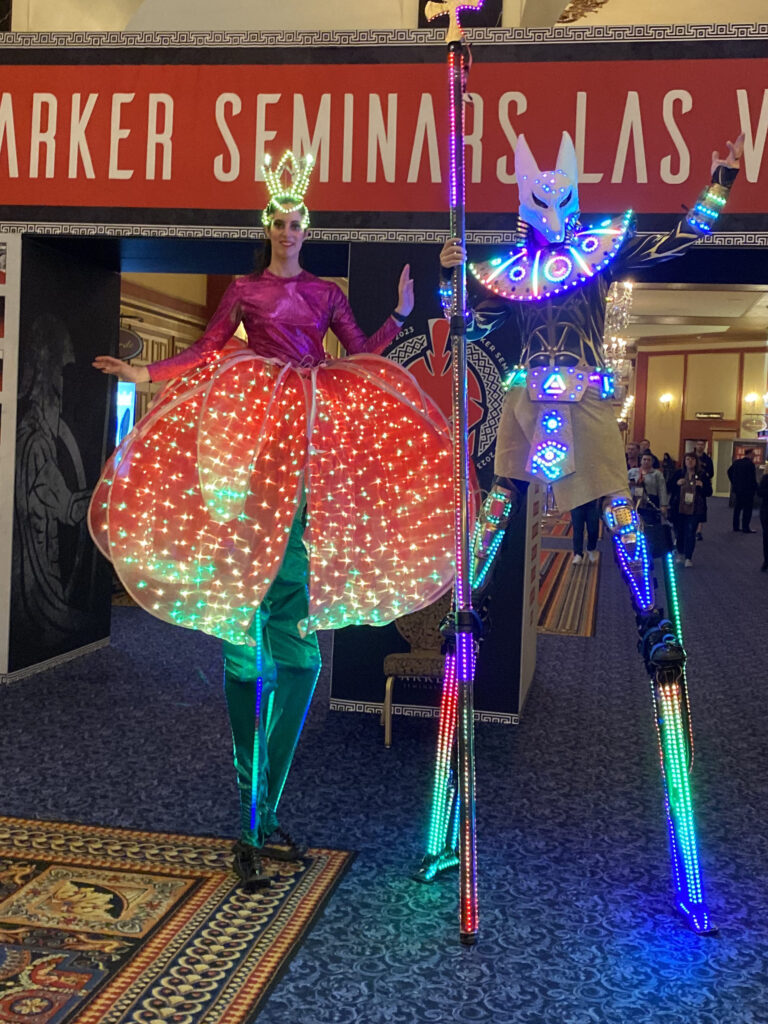
Illuminated and LED performers. Costume-integrated lighting reads across a large, visually busy room in a way that an unlit act does not. On a gaming floor competing with thousands of screens and signs, visibility is not a stylistic question — it is whether the act is noticed at all.
Stilt walkers and scale acts. Height solves the sightline problem. In a room where most guests are seated, an act operating above eye level is visible from much further away than one at floor level — and on a large floor, sightline is the whole game.
Character and costumed performers. Useful when the entertainment needs to carry a theme — a promotion, a seasonal campaign, a property’s own brand identity.
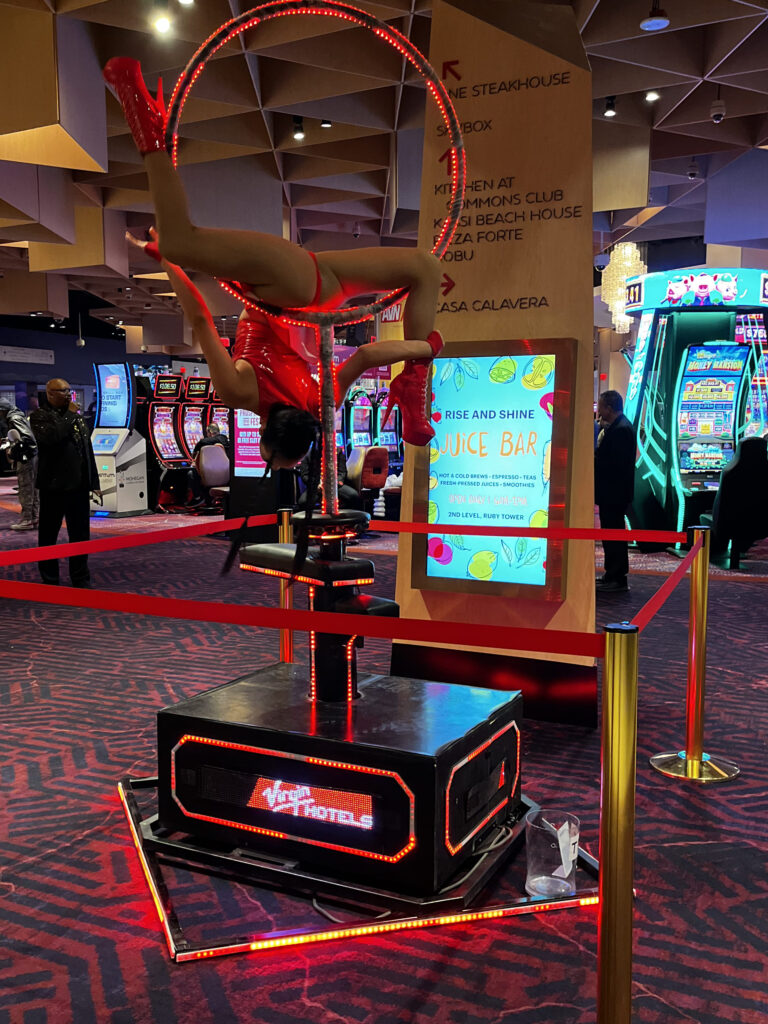
Aerial and specialty acts, where the room allows it. Ceiling height and rigging points are the constraint, and many gaming floors do not have either. Where a property does have a high-ceiling atrium or a void above a bar, that vertical space is worth looking at — it is frequently the one part of the building nothing is currently using.
Interactive installations. Something guests operate, play with or stand inside rather than watch. These hold attention longer than performance does and they generate the photographs that extend the reach of the night past the people in the room.
The placement question matters more than the act. An excellent performer in a dead corner produces nothing. The same performer positioned on the path between the gaming floor and the bar changes traffic.
Entertainment ideas for bars, lounges and the sportsbook
Different rooms, different logic.
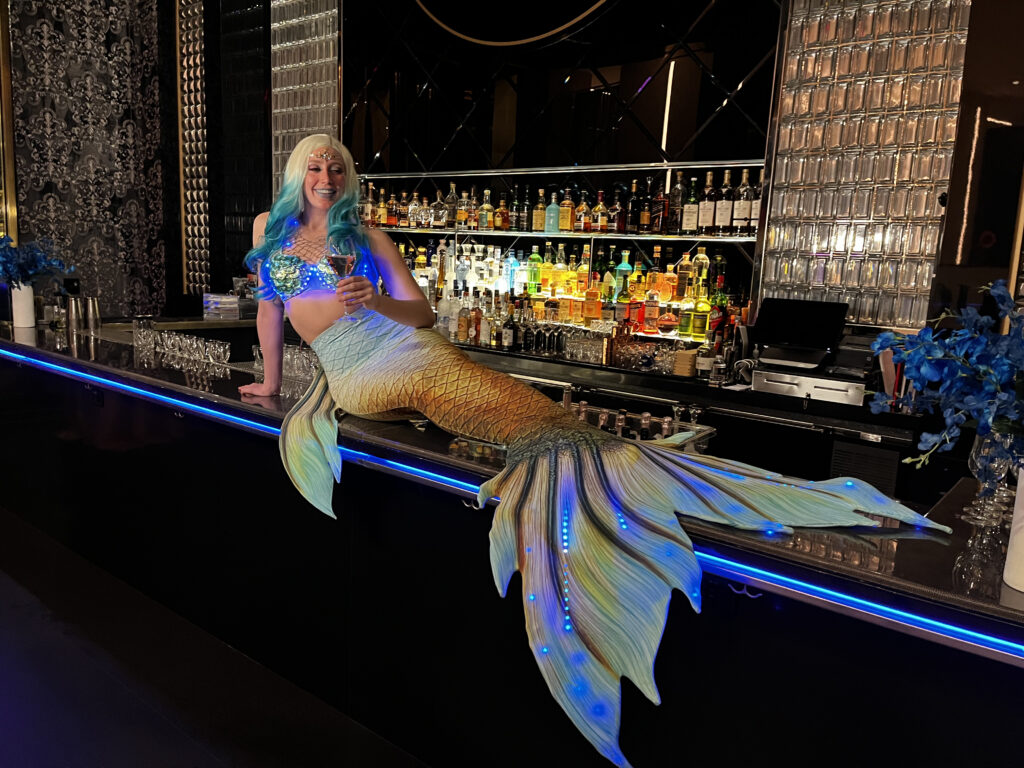
A lounge at 9pm has a seated audience, lower ambient noise and guests who have already decided to stay a while. That supports longer-format entertainment — a set rather than a pass-through, close-up specialty work, anything that rewards attention.
A sportsbook at 1pm on a Sunday is the opposite. The screens have the room’s attention and nothing is going to take it from them. What works there is programming in the gaps: the pre-kickoff window when guests have arrived early to hold seats, halftime, and the concourse and overflow areas where people are moving rather than watching. Football weekends are their own programming discipline — sportsbook entertainment for NFL game days covers that in full.
Bars and restaurants sit between the two. Ambient entertainment during dinner service, something with more energy as the room turns over later in the evening.
Entertainment ideas for player events and invited guests
Player appreciation events, tier parties and tournament finales run on different rules from floor programming, and the most common mistake is booking the same act for both.
Floor entertainment is designed for anonymous traffic — guests who did not come to see it, encountered in passing. Player event entertainment is for a known guest list, in a contained room, in front of people who have been to many of these and can tell the difference between effort and budget. Scale is the usual failure: floor-scale entertainment overwhelms a private room of thirty, and intimate entertainment disappears in a ballroom of three hundred.
The other difference is what the entertainment is for. At a player event it is a tool for the host team — a reason to walk a guest over, introduce them to something, and have a conversation that is not about their play.
Entertainment ideas for outdoor and resort spaces
Pools, patios, event lawns and the porte-cochère are, in our experience, the spaces most often left unprogrammed — a missed opportunity for Southwest properties with a long outdoor season. (No industry body publishes data on how many properties program these areas, so treat that as an observation from the field rather than a statistic.)
Daytime pool programming is a different product from evening floor entertainment — more ambient, more heat-tolerant, built for a crowd that is horizontal and half-asleep. Evening patio programming is where illuminated formats work best, because the darkness does the work that a busy gaming floor fights against.
The arrival experience is worth mentioning separately. A guest’s impression of whether a property “has something going on” is often formed before they reach the gaming floor.
How to choose between the ideas
This is the section that decides whether a programming plan works, and it is the one most entertainment lists leave out. Six questions, in order.
1. What night is it, and what is that night’s problem? A Saturday that fills anyway does not need entertainment to drive attendance — it needs entertainment to raise spend and dwell. A slow Wednesday needs a reason to show up. Those are different bookings.
2. Who is already on property? Programming for the guests you have is cheaper and more reliable than programming to attract guests you do not. Both are legitimate; only one of them is usually budgeted correctly.
3. What does the space physically allow? Ceiling height, rigging points, power, footprint, load-in path. Establish these before you fall in love with a concept. A great idea that cannot be rigged is not an idea.
4. What is the noise tolerance near live gaming positions? This is the constraint that surprises people. Entertainment that a dealer cannot be heard over is an operations problem regardless of how well it performs.
5. What does the host team need to sell? If player development cannot invite anyone to it, the entertainment is doing half a job.
6. Is this a one-night budget or a recurring one? The most consequential question of the six, and the subject of the next section.
Roaming or a featured act?
This is the choice that comes up most often, and it has a fairly clean answer.
Choose roaming when the goal is to change how the floor feels rather than to draw a crowd, when you need coverage across several zones from one booking, when there is no space that can hold an audience without blocking something, and when the night is about atmosphere rather than attendance.
Choose a featured act when you need a reason for someone to make the trip, when you have a room or a space that can gather people without creating a congestion problem, when marketing needs something specific to promote, and when hosts need something concrete to invite players to.
Most properties running regular programming end up with both — roaming as the weekly layer, a featured act as the monthly reason to come back. If you are choosing one to start with, roaming carries less risk: it works in more spaces, it does not depend on drawing a crowd to succeed, and it costs less to test. The floor activation formats that suit a live gaming floor go into more detail on both.
The ideas that work better as a series than as a one-off
Some entertainment produces most of its value the first time. Some produces almost none of it the first time.
A large seasonal spectacle — a New Year’s Eve midnight moment, a grand opening, a tentpole event — is built for scale and singularity. Doing it monthly would cost more and mean less.
But most of the formats above work the other way. Roaming floor entertainment on one Friday is a pleasant surprise. Roaming floor entertainment every Friday is a reason to choose Friday. The behaviour you are trying to create — a habit — only forms with repetition, and a single booking cannot produce it.
Our own view, and the way we would advise a property to think about it: a fixed entertainment budget usually does more spread across a recurring weekly presence plus a handful of larger moments than concentrated into four big nights. The reasoning is that the empty nights are the ones a guest experiences most often, and they are the nights that set the everyday impression of the property.
That is a recommendation, not a measured result. No published study benchmarks the right split between recurring and tentpole entertainment spend, so weigh it against your own occupancy and traffic data rather than treating it as an industry standard.
The complication is that a recurring program goes stale. Regulars — your most valuable guests, and the ones most exposed to repetition — stop seeing an act they have seen eleven times. That is a solvable problem, but it is solved by planning rotation into the program from the start rather than by booking harder.
Where to start
If you are building programming from scratch, start with the night that has the clearest problem and the format with the fewest physical constraints. Roaming or ambient entertainment on a soft weeknight is the lowest-risk place to learn what your floor responds to, and it costs a fraction of a featured booking.
Then measure something. Attendance on comparable nights, bar covers, dwell, host feedback — anything you can compare against a baseline before you scale the investment.
When you are ready to bring in an outside company, brief them on six things: the date and the room, who the audience is (open floor traffic, invited players, a sportsbook crowd), what the entertainment is actually for, your ceiling height and power, your operations and surveillance constraints, and whether this is one date or the start of something recurring. A company that asks for all of that before quoting is a better sign than one that does not — what to look for when hiring a casino entertainment company covers the rest of the vetting.
LightRay is a Las Vegas entertainment and production company. We build entertainment for casino floors — roaming and illuminated performers, specialty and character acts, interactive installations and custom props — and we are set up for recurring programming and rotation rather than one-off bookings.
On the casino side specifically, we have brought LED performers and roaming entertainment into a full-scale resort casino environment at Yaamava’ Resort & Casino in Southern California, and worked nightlife floor activation and branded interactive builds in Las Vegas.
If you are working through what to program and when, see the experience formats we build or start a conversation about your calendar.