The gaming floor is the hardest room in any casino to program. It is never empty, never closed, and every square foot of it is already earning. An activation here has to add energy without taking a position out of service, blocking an aisle, or pulling a dealer’s attention off their game.
That constraint rules out most of what an events company would propose. It also means the properties that get floor programming right have a real advantage, because it is not easy to copy.
What follows is a working guide to casino floor activations — the formats that survive a live gaming floor, where to put them, and the operational questions that decide whether a plan gets approved. For programming beyond the floor itself, the wider set of casino entertainment ideas covers bars, player events and outdoor spaces.
What makes a floor activation different from an event
An event has a stage, a start time, a seated audience and a room that was set up for it. A floor activation has none of those things.
Guests did not come for a show. Ambient noise is constant. There is no sightline the whole room shares. People are moving, and the ones who are not moving are seated at a machine facing away from wherever you put the act.
Three practical consequences:
It has to work in short encounters. Assume ninety seconds of attention, not twenty minutes. Formats that build slowly toward a payoff do not survive on a floor.
It has to read from a distance. In a room full of lit signage and screens, an act that is visually quiet goes unnoticed. This is the practical reason illuminated and raised formats get used so heavily on gaming floors — it is a visibility problem before it is an aesthetic one.
It cannot require silence. Anything that depends on the audience hearing a subtlety will fail, and anything loud enough to guarantee being heard is an operations problem.
Roaming and ambient activations
Performers who move through the floor rather than occupying a fixed point.
The economics are the argument. One roaming booking covers the gaming floor, the bar, the promotion area and the path to the sportsbook over the course of an evening. A fixed act covers one of those. For a property programming a recurring weeknight on a modest budget, roaming is almost always the better value.
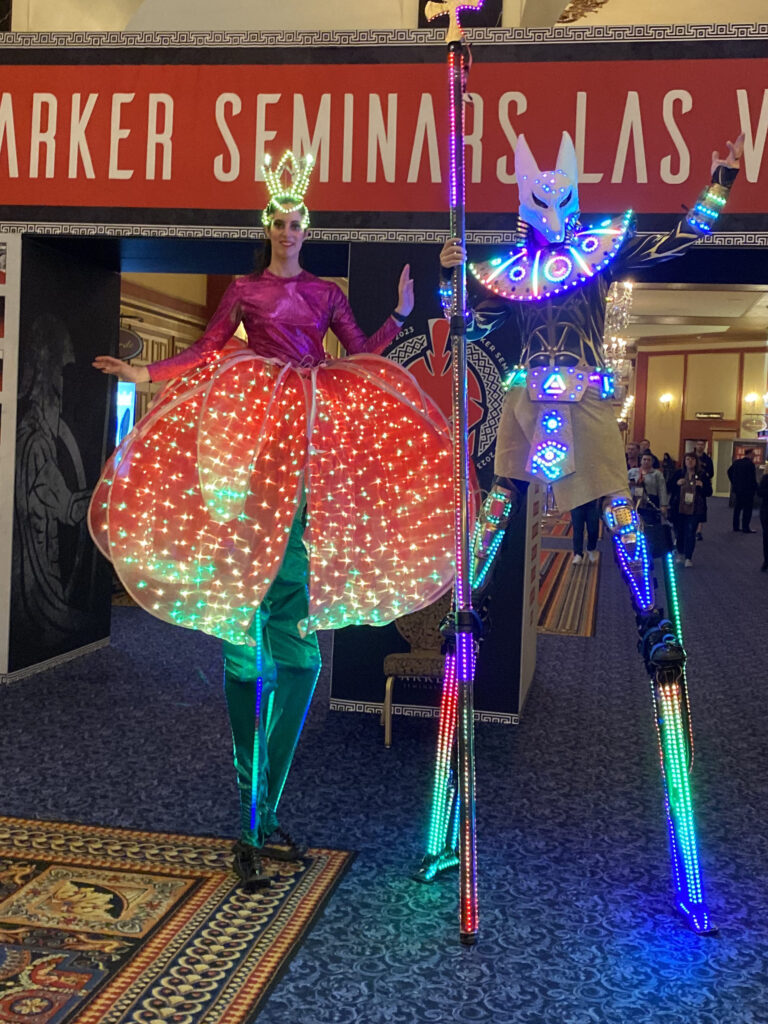
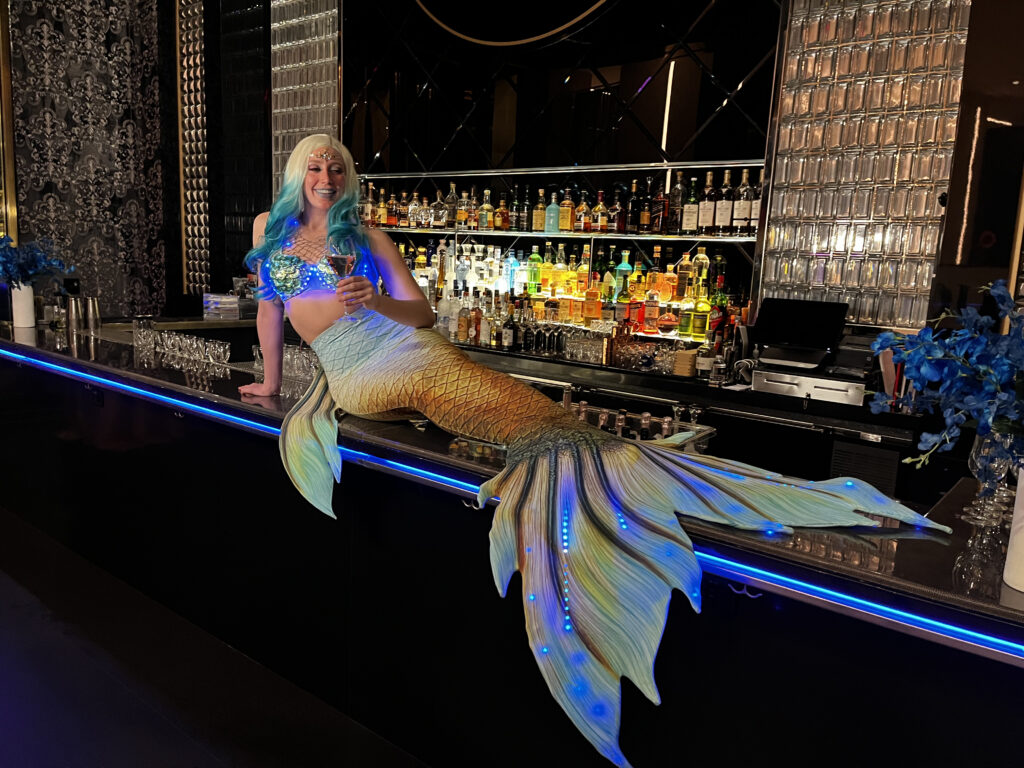
Formats that work: illuminated and LED-costumed performers, character and themed performers, stilt walkers, close-up specialty artists working table to table, and interactive costumed acts that engage guests directly rather than performing at them.
The design question is the route, not the act. A roaming performer needs a path that hits the zones you want energy in, at the times those zones need it — arrival areas early, the bar as the evening turns over, the promotion area before a drawing.
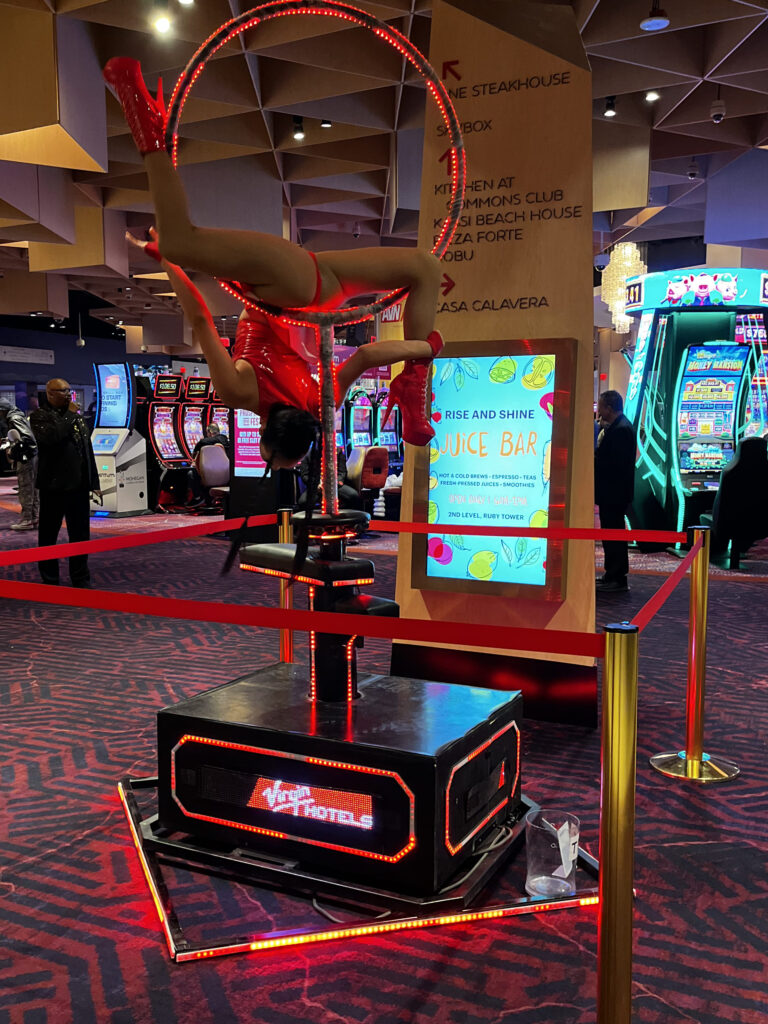
Our own Las Vegas nightlife floor activation ran on this principle: hoop and LED performers working a packed club floor, with the entertainment placed in the crowd rather than on a stage. On a full floor, that reaches people a stage cannot.
Anchored activations that draw a crowd to one point
Sometimes you do want people to gather. An aerial rig under a high ceiling, an LED installation, a photo moment, a small stage near a bar.
The trade-off is crowd draw against floor congestion, and it is resolved by placement rather than by scale. An anchored activation positioned so the crowd it gathers feeds the bar or the promotion desk is an asset. The same activation twenty feet away, where the crowd blocks a main aisle, is a complaint from operations by 9pm.
Two placement rules worth applying:
- Put the gathering point adjacent to something that monetises attention — a bar, a promotion kiosk, a restaurant queue — not in the middle of open circulation.
- Leave the crowd somewhere to spill. A gathering space with one exit becomes a congestion problem the moment it works.
Interactive and photo-driven activations
Experiences guests participate in rather than watch: installations they operate, oversized games, illuminated furniture and props they can use, photo moments built for a specific backdrop.
Two arguments for them over purely passive entertainment on a floor.
Participation renews itself. Watching is a decision a guest makes once; participating is a decision they keep making, which is why interactive formats tend to hold a guest in place longer than a performance does.
And they extend past the room. A guest who photographs an activation carries the night to an audience that was not on property — which is the only mechanism by which a Tuesday floor activation reaches anyone who was not already there.
“Will a guest photograph this” is a legitimate selection criterion, not a vanity one. It is a distribution question. Our own build for a branded Las Vegas activation was an illuminated mechanical bull, made to work as a photo and participation moment.
What actually makes an activation photographable is fairly mechanical:
- A defined vantage point. Somewhere a guest can stand where the shot works. If the good angle is only obvious to a photographer, most guests will not find it.
- Light on faces, not just on the installation. A brilliantly lit prop with a silhouetted guest in front of it does not get posted.
- Something in frame that identifies the property, ideally without a logo doing the work — a recognisable architectural feature, a signature colour, a custom element built for you.
- Room for a group. Most casino guests are not alone. An activation sized for one person gets half the photographs.
- A reason to take it now. Something changing, moving or lit that will not be there tomorrow beats a permanent installation guests assume they can shoot any time.
LightRay’s LED furniture and interactive rentals sit in this category, and they combine well with roaming performers — the installation gives guests a reason to stop, the performer gives them a reason to notice it.
Activations that support a promotion already on the books
One of the strongest uses of floor entertainment is not a standalone booking at all. It is entertainment attached to a promotion the property is already paying for.
Most promotions have dead time built in. Guests arrive early to be present for a drawing and then wait. The drawing itself is frequently a name read over a PA. Both are cheap to fix and both change how the entire promotion feels, without changing the promotion’s mechanics or its prize budget.
If you have a promotion on the calendar and a small budget, this is the cheapest place to get a visible result: the audience is already assembled and the incremental cost is small against a promotional spend that is already committed.
The operational questions to answer before you book
This is where floor activations succeed or fail, and where a partner who has actually worked a gaming floor separates from one who has not.
Ceiling height and rigging. Not just the number — where the structural points are, what they are rated for, and who at the property signs off on a rig.
Power. How much, where it comes from, and how the run gets from the source to the activation without crossing a guest path.
Noise relative to gaming positions. Establish the acceptable level with operations before booking, not after the sound check. It is a frequent reason a floor activation gets shut down partway through a run.
Traffic flow and egress. Where the crowd forms, what it blocks, and whether it interferes with a marked egress path.
Surveillance sightlines. An installation or a set of props that blocks a camera’s view of a gaming position will not be approved, however good it looks. Surveillance should see the plan early, not on the day.
Load-in path and timing. A 24-hour floor has no closed window. Load-in happens around live play, which affects the equipment you can use and the hours the crew works.
Costume and prop clearance. Properties have standards on coverage, on anything that resembles a uniform or a security presence, and on props that could be mistaken for something they are not. Ask early.
Vendor licensing and insurance. Certificate of insurance with the property named as additional insured is standard. For tribal properties, vendor licensing through the tribal gaming commission is a separate process with its own timeline.
Both are real processes with published rules, and they are worth understanding before you shortlist. Vendor licensing runs through the property’s own tribal gaming commission and genuinely does vary by nation. The Yuhaaviatam of San Manuel Nation issues a two-year gaming resource supplier licence and requires the vendor to be referred by the property’s procurement department before it can even apply. The Citizen Potawatomi Nation sets its threshold at $25,000 of goods or services in any twelve-month period, and at any amount for gaming equipment. The Little River Band of Ottawa Indians charges a sliding licence fee by annual sales volume.
A state layer can sit on top of that. In California, a gaming resource supplier licensed by the tribal gaming agency must also obtain a finding of suitability from the state Bureau of Gambling Control. Arizona works differently again — the American Gaming Association’s state fact sheet notes that tribal licensing fees there are set individually by each tribe and are not published in the compacts or ordinances.
Insurance is a separate question with a less tidy answer: there is no published industry norm for the certificate of insurance limits a gaming property will ask a vendor to carry. Those sit in the property’s own procurement and contracting process, not in gaming regulation, so ask for the requirement early and in writing rather than assuming a standard figure.
Who has to approve it, and in what order
A floor activation touches more departments than an event in a ballroom does, and plans die late because the wrong person saw them last.
The approval path at most properties, roughly in sequence:
Marketing or entertainment owns the concept and the budget, and is usually who you are talking to.
Operations and the casino floor manager decide whether it interferes with play. Their concerns are traffic, noise and anything that takes a position out of service. Bring them in before the concept is finalised, not after.
Surveillance signs off on sightlines. This is the approval most often left until last and the one most likely to require a change.
Facilities and engineering handle power, rigging points and load-in access.
Security cares about crowd size, egress and anything a costume or prop could be mistaken for.
Risk or legal review the certificate of insurance and the contract. At tribal properties, vendor licensing runs through the tribal gaming commission on its own timeline, which is frequently the longest lead item in the whole project.
The practical version: get operations and surveillance to look at a rough concept early, while it is still cheap to change. An entertainment company that asks who needs to approve this — before quoting — has done it before.
Building a floor activation into a repeating program
A single activation is a good night. A recurring one is a reason to choose your property on a particular night of the week, which is a different and more valuable thing.
The mechanics are straightforward: fix the night, fix the general shape, and rotate what fills it. What should stay constant is the slot and the quality level. What should change is the act — because the guests who matter most are the ones on your floor most often, and they are the first to stop noticing something they have already seen.
Where to start
Two different entry points, depending on what you are trying to learn.
If you want a visible result on a budget you have already committed, attach entertainment to a promotion that is already on the calendar. Lowest cost, fastest read, no new budget line.
If you want to know what your floor responds to, pick one soft night and one zone, and program it with a roaming format for four consecutive weeks rather than one showcase night. Then compare bar covers and dwell in that zone against a comparable night. Four weeks is enough to see whether guests start expecting it, which is the signal that matters.
LightRay is a Las Vegas entertainment and production company. We build and staff floor activations — roaming and illuminated performers, interactive installations, and custom props and costumes built to a property’s own campaign — and we work through the rigging, power, clearance and licensing requirements above as part of scoping, not after it.
That includes bringing LED performers and roaming entertainment into a full-scale resort casino environment at Yaamava’ Resort & Casino in Highland, California.
Have a look at our casino experience formats, or talk to us about a concept for your floor. If you are still deciding what to program and when, the wider guide to casino and resort entertainment covers the full range.